One of the most common misconceptions about language learning is that you need to be very young in order to reach a high level of proficiency/fluency in a language. While it may be advantageous to have many years ahead of you, it is not an absolute necessity. Dr. Mary Hobson took on the task of learning Russian at 56 years old. She not only managed to achieve a high level of proficiency in Russian, but she also finished her Ph.D at the age of 74 and received the Pushkin Gold Medal for translation. When one looks at the achievements of Dr. Hobson, one can understand that older language learners can be very successful if they have a high level of motivation and interest. So, if you are older and are having second thoughts about taking up a new language simply because of your age, take a closer look at Dr. Hobson's story and think again!
There are already numerous articles written about Dr. Hobson in English and Russian, and a small number of videos have also been released. In this video, for example, Dr. Hobson reads aloud her own English translation of the opening to Pushkin's Eugene Onegin, then talks in Russian about how she started to learn Russian and how she first came across Tolstoy's War and Peace.
An interview with Dr. Hobson in Moscow was recently filmed and uploaded to YouTube. The interview lasts an hour and twenty minutes, and I have provided a short summary of the Russian-language portion of the video (this is for those who are interested in the content but don't understand Russian; everyone else can get the information directly from the video). It's not meant to be a word-for-word translation; just a general idea.

The first half of the interview was mostly in Russian, then the interview shifted to Dr. Hobson reading the English translations of Pushkin's works while a native Russian speaker read aloud the Russian version. A Q&A session occurred afterwards - it began in Russian but continued in English (this was done so that students who don't speak Russian would still be able to understand her thoughts while watching the video).
According to the interviewer, Vladimir Nabokov said that it was impossible for one to translate the verses of Pushkin into English-language verses without distorting the literal meaning. The interviewer remarked that Dr. Hobson was able to not only render Pushkin's verses into literally accurate English verses, but she was able to do the same with those of Griboedov's, which are full of metaphors.
Dr. Hobson said that she was in the hospital for two weeks, and her daughter, Emma, came to her with a copy of Tolstoy's War and Peace, saying "Here, Mom! There won't ever be a better time to read War and Peace." She mentioned that this was the first time in her life that she had read Russian literature, and the impression was enormous; when she had arrived at the last page, she asked herself, "Where have Pierre and all of these characters gone off to?" Dr. Hobson realized that she had not read War and Peace, but simply a translation of the work. Her first thought was a sad one - "I am never going to read War and Peace in the original!", but her second thought was an inspirational one - "I need to learn Russian so that I can read it!".
Dr. Hobson originally started learning Russian when she was 56, but at age 62 she decided to take a more serious approach to her Russian studies, and she enrolled at the University of London, where she studied for four years (including one year spent in Moscow, studying at the Moscow State Linguistic University). A professor in Moscow told her that there was a great comedy written by Griboedov called Woe from Wit (Горе от ума) that was impossible to translate into English. Dr. Hobson thought, "Maybe it is possible, who knows!". She went to the university library, took a copy of Woe from Wit, and started working on an English translation, noting that the text was full of witty characters and colorful personalities.
Dr. Hobson started looking at the works of Pushkin only after she had already done a lot of reading in Russian. An old immigrant had given her a copy of The Bronze Horseman (Медный всадник) as a gift. This was the very first poem that Dr. Hobson had translated. A little more than a year ago, Dr. Hobson re-read the translation that she had made during that time (this was circa 1990), and she thought to herself, "Oh, the horror! It's so bad, I need to do it all over!". Dr. Hobson re-translated it, of course.
Dr. Hobson's favorite work of Pushkin's is Eugene Onegin. She reads aloud sections of her English translation of Eugene Onegin, noting that she now knows the translation by heart as a result of having worked so hard on it. Dr. Hobson said that when had gotten to the end of her translation, she felt almost in tears and started to wonder how Pushkin felt when he had finished his masterpiece.
In 1991, Dr. Hobson bought around 200 books while she was still in Russia. Her favorite literary period is the 19th century, and her favorite author of that period is Jane Austen. She sees the same kind of "surprising simplicity" in the works of Austen as she sees in the works of Pushkin.
Further in the video, Dr. Hobson read aloud some of her English translations of Pushkin's works while a native Russian speaker read aloud the original Russian.
From the questions:
Dr. Hobson noted that English sentences often are in the meter of the iamb. What she searches for in her translations are places where there is a shared rhythm in both the original Russian and the English. She thinks this is the reason why it may be easier to translate poetry from Russian to English than, for example, from Russian to German. (The rest of the Q&A was in English - you can listen to the remaining questions by following the link.)
Anyway, I think the entire interview is worth watching! For those interested in more information, here are some additional links:
There are already numerous articles written about Dr. Hobson in English and Russian, and a small number of videos have also been released. In this video, for example, Dr. Hobson reads aloud her own English translation of the opening to Pushkin's Eugene Onegin, then talks in Russian about how she started to learn Russian and how she first came across Tolstoy's War and Peace.
An interview with Dr. Hobson in Moscow was recently filmed and uploaded to YouTube. The interview lasts an hour and twenty minutes, and I have provided a short summary of the Russian-language portion of the video (this is for those who are interested in the content but don't understand Russian; everyone else can get the information directly from the video). It's not meant to be a word-for-word translation; just a general idea.
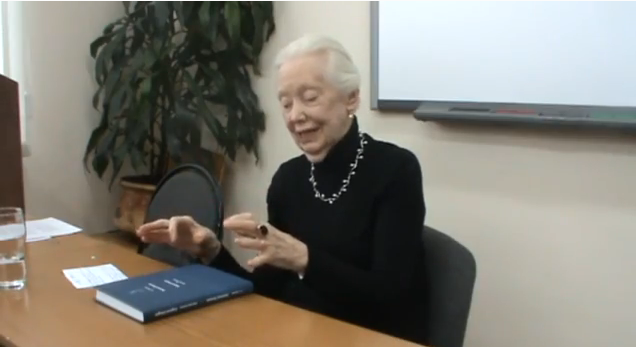
Dr. Hobson sharing her translation work with staff in Moscow.
The first half of the interview was mostly in Russian, then the interview shifted to Dr. Hobson reading the English translations of Pushkin's works while a native Russian speaker read aloud the Russian version. A Q&A session occurred afterwards - it began in Russian but continued in English (this was done so that students who don't speak Russian would still be able to understand her thoughts while watching the video).
According to the interviewer, Vladimir Nabokov said that it was impossible for one to translate the verses of Pushkin into English-language verses without distorting the literal meaning. The interviewer remarked that Dr. Hobson was able to not only render Pushkin's verses into literally accurate English verses, but she was able to do the same with those of Griboedov's, which are full of metaphors.
Dr. Hobson said that she was in the hospital for two weeks, and her daughter, Emma, came to her with a copy of Tolstoy's War and Peace, saying "Here, Mom! There won't ever be a better time to read War and Peace." She mentioned that this was the first time in her life that she had read Russian literature, and the impression was enormous; when she had arrived at the last page, she asked herself, "Where have Pierre and all of these characters gone off to?" Dr. Hobson realized that she had not read War and Peace, but simply a translation of the work. Her first thought was a sad one - "I am never going to read War and Peace in the original!", but her second thought was an inspirational one - "I need to learn Russian so that I can read it!".
Dr. Hobson originally started learning Russian when she was 56, but at age 62 she decided to take a more serious approach to her Russian studies, and she enrolled at the University of London, where she studied for four years (including one year spent in Moscow, studying at the Moscow State Linguistic University). A professor in Moscow told her that there was a great comedy written by Griboedov called Woe from Wit (Горе от ума) that was impossible to translate into English. Dr. Hobson thought, "Maybe it is possible, who knows!". She went to the university library, took a copy of Woe from Wit, and started working on an English translation, noting that the text was full of witty characters and colorful personalities.
Dr. Hobson started looking at the works of Pushkin only after she had already done a lot of reading in Russian. An old immigrant had given her a copy of The Bronze Horseman (Медный всадник) as a gift. This was the very first poem that Dr. Hobson had translated. A little more than a year ago, Dr. Hobson re-read the translation that she had made during that time (this was circa 1990), and she thought to herself, "Oh, the horror! It's so bad, I need to do it all over!". Dr. Hobson re-translated it, of course.
Dr. Hobson's favorite work of Pushkin's is Eugene Onegin. She reads aloud sections of her English translation of Eugene Onegin, noting that she now knows the translation by heart as a result of having worked so hard on it. Dr. Hobson said that when had gotten to the end of her translation, she felt almost in tears and started to wonder how Pushkin felt when he had finished his masterpiece.
In 1991, Dr. Hobson bought around 200 books while she was still in Russia. Her favorite literary period is the 19th century, and her favorite author of that period is Jane Austen. She sees the same kind of "surprising simplicity" in the works of Austen as she sees in the works of Pushkin.
Further in the video, Dr. Hobson read aloud some of her English translations of Pushkin's works while a native Russian speaker read aloud the original Russian.
From the questions:
Dr. Hobson noted that English sentences often are in the meter of the iamb. What she searches for in her translations are places where there is a shared rhythm in both the original Russian and the English. She thinks this is the reason why it may be easier to translate poetry from Russian to English than, for example, from Russian to German. (The rest of the Q&A was in English - you can listen to the remaining questions by following the link.)
Anyway, I think the entire interview is worth watching! For those interested in more information, here are some additional links:
- BBC Interview in 2012 with Dr. Hobson (in English - it starts after 18 minutes)
- Article from 2010 showing Dr. Hobson receiving the Enthusiast translation prize
- Dr. Hobson's translation of Eugene Onegin available in audiobook format


